
Dialogue Trip 2026
Impressions from the First BayCHINA Dialogue Trip to China
“Servus, China” was our farewell after two intensive weeks filled with meetings and discussions that took us from Beijing and Shanghai to Shenzhen. The first BayCHINA Dialogue Trip took place several weeks ago and provided a delegation of 14 early-career researchers from a wide range of academic disciplines with the opportunity to experience China first-hand – for many of them, for the very first time. Below, you will find some impressions and highlights from the trip.
Kick-off in Beijing
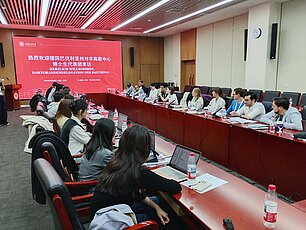
Following their arrival, the visit to the China University of Political Science and Law (CUPL) marked the beginning of the trip. The visit was organised and accompanied by colleagues from the BayCHINA Liaison Office in Beijing. Participants first met with representatives of the DAAD and EURAXESS for an introductory briefing on China as a research location. They received information on the work of these organisations, the Chinese research landscape, and current developments in science and research policy, including the latest Five-Year Plan.
This was followed by an introduction to AI regulation and data law in China by Professor Zhang Linghan, as well as a presentation by Tang Yan on CUPL’s internationalisation strategy and educational alliances in the field of legal studies. Participants then had the opportunity to engage in discussions with doctoral candidates and students from CUPL. A visit to the university canteen and a short tour of the library rounded off the programme, providing the delegation with valuable insights into Chinese higher education and campus life.
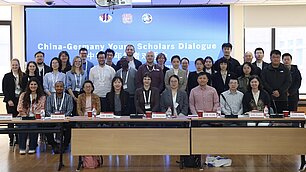
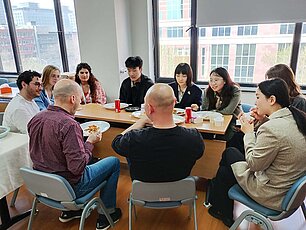
The academic exchange continued the following day at Renmin University. After a welcome address by Professor Xu Zhengyuan and Professor Meng Hong, who greeted all participants in both German and Chinese, selected representatives from both sides introduced their current research projects and areas of expertise. A shared lunch provided ample opportunity for informal discussions, networking, and a deeper understanding of each other’s academic systems.
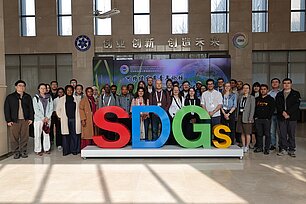
In the afternoon, participants visited the International Research Center of Big Data for Sustainable Development Goals, where they learned more about one of China’s major data research centres and exchanged experiences with international PhD candidates pursuing their doctorates in China. Following a guided tour of the centre by Dr Chen Bowen, the delegation received insights into current research projects, including work on cultural heritage and coastal protection, as well as methods of data collection, such as the use of satellite technologies.
The final day in Beijing focused on discussions with representatives of German political foundations and research institutions based in China. The group was introduced to the work of the Rosa Luxemburg Foundation, the Konrad Adenauer Foundation, and the Fraunhofer Institute in Beijing. Following presentations on their respective projects and activities, an engaging and lively Q&A session developed. Participants were particularly interested in learning more about the personal career paths and professional experiences of the speakers.
Exchange in Shanghai
The Dialogue Trip then took the group to Shanghai. In addition to visiting universities, the programme also included visits to a company and the German Consulate General. The very first day offered a full schedule.
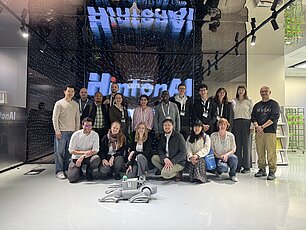
The group began with a visit to HintonAI, a relatively young company providing AI-based solutions for industry and business. Following an introduction by founder and CEO Li Keping, participants had the opportunity to explore the company’s various robotics testing stations first-hand. A particular highlight for many was undoubtedly taking the robotic dog for a walk.
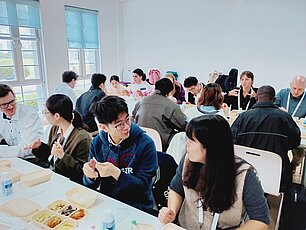
The programme then continued at Fudan University. Thanks to the organisation of Chen Jiehong from the Student Mobility Office, the delegation was able to meet and exchange ideas with PhD candidates from Fudan University over lunch. This was followed by presentations on Fudan University and its broader internationalisation strategy, as well as a specialist lecture from the field of chemistry on “Fibre-Shaped Light-Emitting Diodes”. The academic dialogue continued during a short tour of the campus.
The day concluded with a visit to the German Consulate General in Shanghai. There, the group had the opportunity to speak with members of staff, in particular Uwe Koch, Consul for Science and Technology, about Shanghai as a centre for science and research. Mr Koch responded in detail to the delegation’s questions regarding living and conducting research in China, as well as current developments in the country.
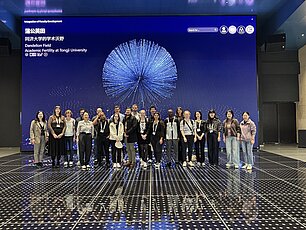
The second and final day in Shanghai was spent at Tongji University. Following a warm welcome from Su Jiwen of the International Office, the group visited the Gallery of Tongji University History to learn more about the institution’s long history and its close German–Chinese connections. As one of the first visiting groups, the delegation was then given a tour of Tongji University’s new Smart Campus Cockpit, followed by a visit to the Chinese-German College. There, participants were guided through the library and had the opportunity to reflect on the morning’s impressions over lunch.
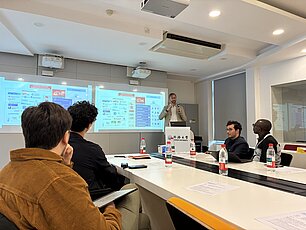
In the afternoon, the programme continued with a meeting at the Sino-German College involving Dr Jan Harder and PhD candidates. Following a welcome address by Yin Wen, Director of the International Affairs Office, both sides gave presentations. Particularly insightful was a comparative presentation on higher education in China and Germany. Afterwards, participants had ample time to engage in small-group discussions on topics such as higher education systems and PhD structures, international collaboration and mobility, and academic culture.
Conclusion in Shenzhen
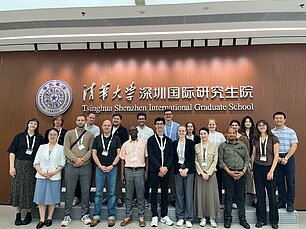
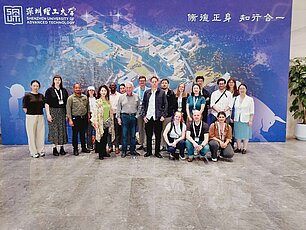
The Dialogue Trip concluded in Shenzhen – one of China’s leading centres for innovation and technological development. There, the delegation visited the campus of Tsinghua SIGS, the Shenzhen Institutes of Advanced Technology (SIAT), and the campus of the recently established Shenzhen University of Advanced Technology (SUAT). At Tsinghua SIGS, the focus was primarily on introducing the institution and its research environment, but also on talent recruitment. Participants received an overview of early-career researcher recruitment from Professor Gan Li, Deputy Director of the Human Resources Department. The programme also included laboratory visits, a campus tour, and a shared lunch with international PhD candidates.
The group was then welcomed at SIAT. Following a Q&A session with Professor Helmut Kettenmann from Germany and two members of his research team, participants were given a tour of the Brain Facility and later visited the SUAT campus.
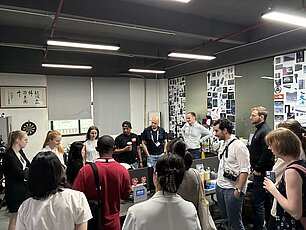
On the final day of the Dialogue Trip, the delegation visited two companies with different areas of focus: iMakerbase and Siemens Healthineers. iMakerbase supports start-ups from around the world throughout the entire innovation process, from the initial idea to the finished product, and assists them in entering the Chinese market. Following a company presentation, participants were also introduced to a number of the start-ups based on site.
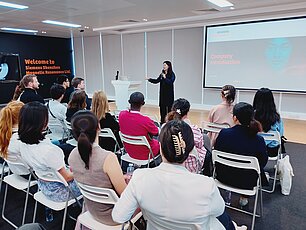
The programme then continued with a visit to Siemens Healthineers. Here, the delegation received an introduction to the company and its products, followed by a guided tour of the local production facilities. The visit provided valuable insights into the supply chain operations of a German company in China. This company visit marked the conclusion of the programme and, with it, the end of the BayCHINA Dialogue Trip 2026. After visiting Nantou Ancient City, the group travelled to the airport and began their return journey to Frankfurt.
Alongside the academic dialogue as well as the various visits and appointments at Chinese universities and research institutes, the participants of the dialogue trip also had time to get to know the country and its people. In addition to a comprehensive cultural programme, there was ample opportunity for individual exploration at the various locations. In this way, the group not only gained an impression of China’s scientific and higher education landscape, but also of Chinese culture and everyday life on site. Whether paying via app or ordering using a QR code – the participants became familiar with daily life locally and were also able to experience China’s rich culture through visits such as to the Forbidden City in Beijing or by taking part in a food tour in Shanghai.
Away from this, there was at all times the opportunity to discuss impressions and insights within the group and with the accompanying staff, and to reflect on them together. In this way, positive synergies and exchange effects also emerged beyond the official programme.
Once again, we would like to express our sincere thanks to all cooperation partners in China and Bavaria who made this trip possible through their contacts. We would also like to thank all universities, institutions and companies that welcomed our group on site and enabled the academic dialogue – in particular China University of Political Science and Law, Tongji University, and Tsinghua SIGS for their kind invitation to the delegation. We look forward to continued fruitful cooperation in Sino–German academic exchange!